
Introducing LUCANA foundation world model for physical intelligence.
Designing physical systems from molecules to manufacturing through cross-scale inverse design.
The industrial problem
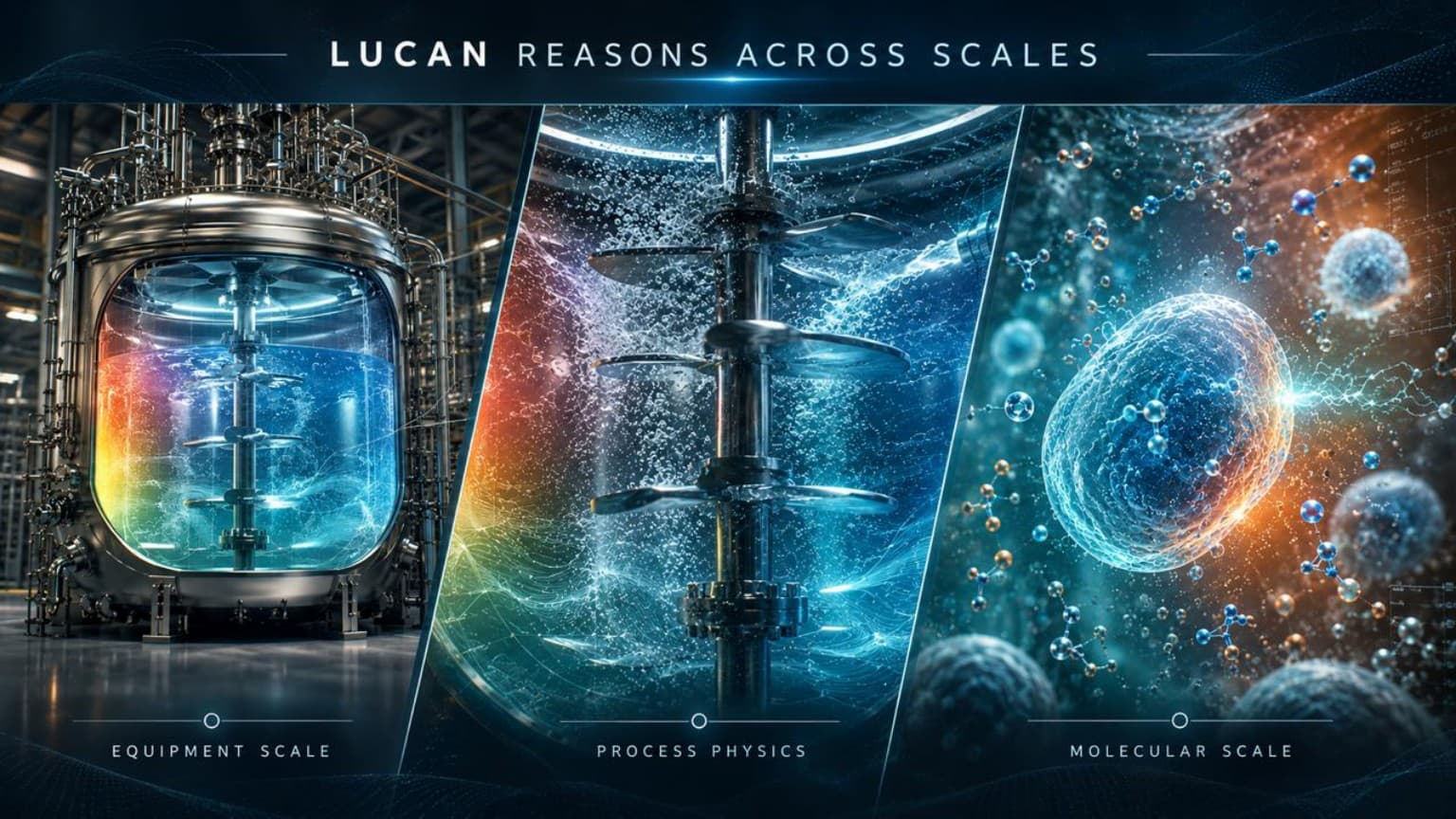
Manufacturing is not one physics problem.
A molecular decision changes reaction energetics. Those energetics change heat release. Heat release changes reactor transport. Reactor transport changes the forces experienced by a material or a living cell. The final product emerges from the whole chain.
Yet most engineering software splits that chain into separate tools and manual hand-offs. Each simulator can answer what happens inside its own domain. The harder question is how to move backward from a desired factory outcome to the molecular and process variables that should change.
Given the outcome we want, what should we change?
A different engineering loop
From prediction to intervention.
LUCAN is designed to preserve a differentiable path across physical scales, so the computational system can propose a direction through the design space before independent physics verification.
“What happens if we do this?”
“What should we change to make this happen?”
One model, typed physics
A shared computational system without flattening the science.
LUCAN maps domain-specific representations into a shared Sparse Mixture-of-Experts architecture. Molecular graphs, three-dimensional fields, and deforming geometries retain their scientific structure while participating in one cross-scale design space.
Five controlled questions
Testing physical intelligence across scales.
The whitepaper moves from shared computation, to controlled cross-scale interventions, to nonlinear coupled regimes, and finally to a declared full-chain composition test.
Shared computation
Does one model share computation across physical domains?
A frozen-checkpoint routing audit reports substantial shared computation between molecular and reactor representations, alongside domain-responsive expert routing.
Micro to macro
Can a molecular change propagate to reactor scale?
Controlled reaction-enthalpy changes produced the expected reactor-temperature direction on held-out 250-liter geometries, with a reported spatial temperature nRMSE of 0.00300.
Macro to micro
Can reactor conditions propagate back to microscopic mechanics?
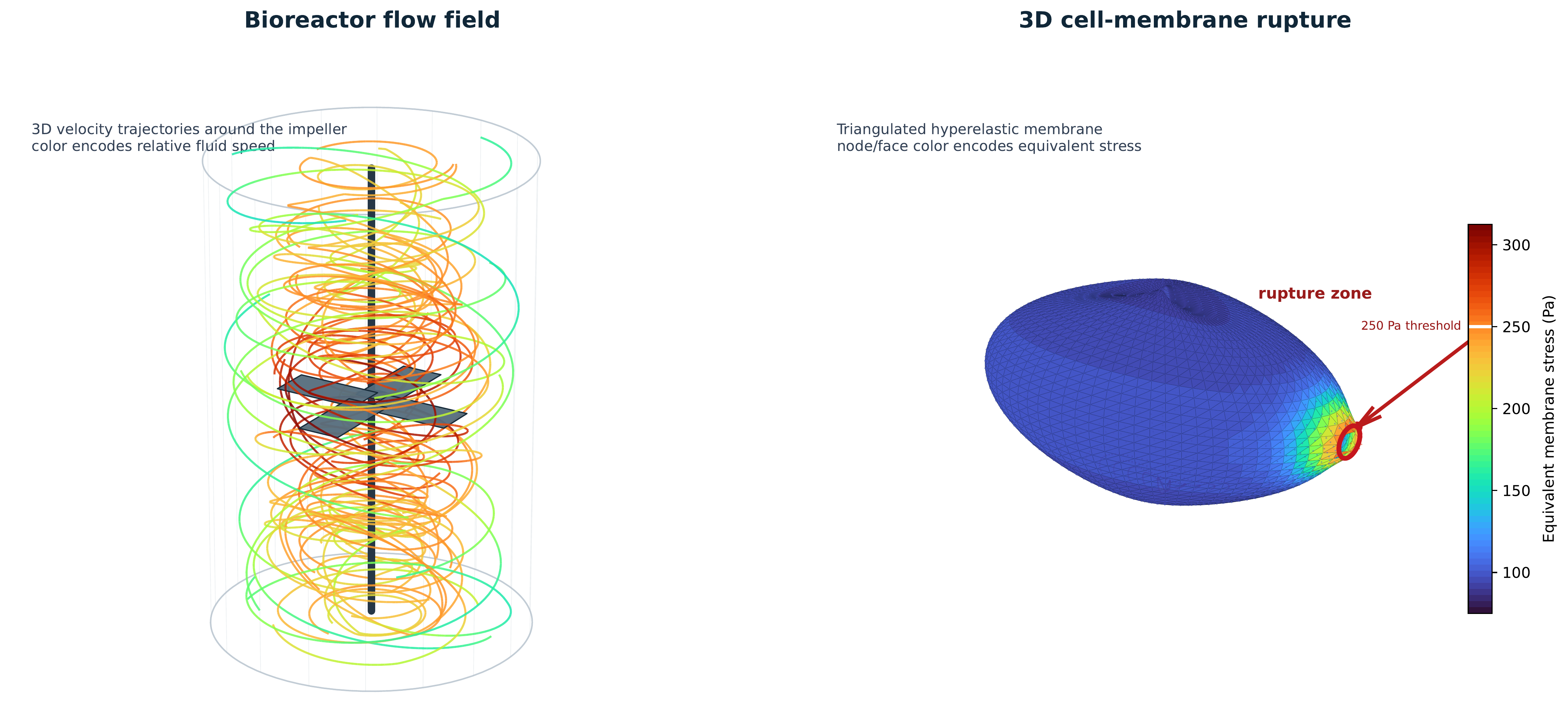
A 5,000-liter reactor flow field was coupled to a 15-micrometer membrane model. The reported stress exceeded the declared 250 Pa rupture threshold; a stricter virtual-work diagnostic remained unresolved.
Competing mechanisms
Can LUCAN find the boundary where one benefit plateaus?
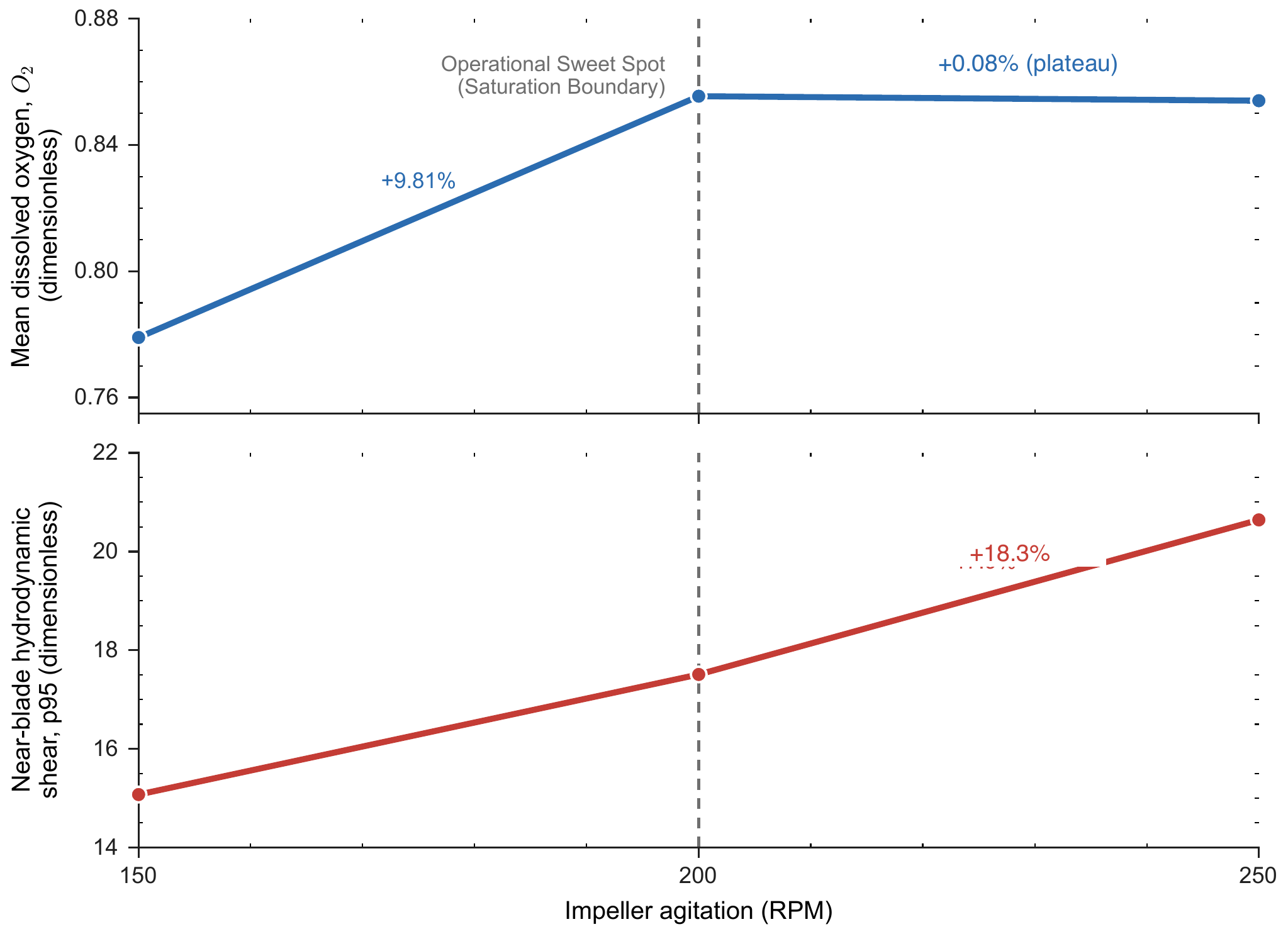
Between 200 and 250 RPM, reported mean oxygen changed by only +0.08% while mechanical shear continued to rise, exposing a practical operating boundary.
Full-chain composition
Can the molecule-to-reactor-to-cell pathway stay connected?
Whitepaper v3 reports an integration test linking molecular representations, thermochemistry, reactor response, fluid-mechanical exposure, and cell mechanics. It does not specify the underlying case count for this percentage.
Source: LUCAN whitepaper v3, Section 3, pages 5–9. These are the results reported for the evaluated checkpoint and test conditions.
Macro to micro
From reactor flow to cell mechanics.
The reported coupling transfers a turbulent reactor field to a cell-scale membrane model. Maximum equivalent stress reached 340 Pa and maximum area strain reached 4.8%, above the declared rupture thresholds of 250 Pa and 3.5%.
The whitepaper labels the graphic an illustrative reconstruction. Direct volumetric solver fields were not supplied for rendering, and the stricter virtual-work consistency gate remained unresolved.
Competing mechanisms
Balancing oxygen transfer and mechanical shear.
In the reported 10-liter bioreactor sweep, oxygen transfer had effectively plateaued from 200 to 250 RPM while near-blade hydrodynamic shear increased by 18.3%. A model that sees both responses can identify when more agitation stops helping and starts adding risk.
The breakthrough
Cross-scale inverse design.
The useful result is not merely a faster neural forward pass. It is a gradient that points toward an intervention which still improves the objective when evaluated by a separate, high-fidelity classical workflow.
of proposed neural directions improved the frozen objective in a separate classical verifier
feasible targets reached solver-verified solutions
intentionally infeasible targets were rejected
median classical solver calls bypassed per target
Reported end-to-end time includes final high-fidelity classical verification.
From computation to execution
Does the intervention survive contact with the physical process?
The whitepaper separately labels prospective industrial executions, where model-generated operating regimes were frozen before partner-run physical evaluation.
Specialty chemical batch-to-continuous scale-up
A reported LUCAN-generated continuous-flow window targeted higher isolated yield while bounding a temperature-sensitive impurity pathway.
Reported prospective pilot execution
5L-to-500L biomanufacturing scale-up
The reported trajectory jointly addressed oxygen transfer, cell viability, shear, and downstream filtration quality across a 100× scale increase.
- Harvest titer
- 6.63 g/L
- Cell viability
- 78.2%
- Product recovery
- 94.5%
- HMW aggregates
- 1.2%
Reported 500L physical pilot run
How to read the evidence
From model predictions to physical validation.
Frozen model on predefined held-out computational tasks.
Model-generated interventions checked by separate classical numerical solvers.
Frozen interventions carried into a laboratory, pilot, or industrial environment.
All results on this page are summarized from the Shodh AI technical whitepaper v3: cross-scale tests in Section 3, inverse-design results in Section 4, and industrial cases in Section 5. Process identities and some source records remain confidential under commercial agreements. The accelerated three-day formulation-screening result described in the paper is not presented as physical validation because its corresponding twelve-week stability outcome remains pending.
LUCAN is a capability release. Model weights, training-corpus composition, and internal implementation details are not released with this whitepaper. Shodh AI acknowledges the IndiaAI Mission for GPU compute support.
Read the technical whitepaper
LUCAN: A Foundation World Model for Physical Intelligence
Architecture, falsification controls, five cross-scale tests, inverse design, and physical execution.